
Introduction
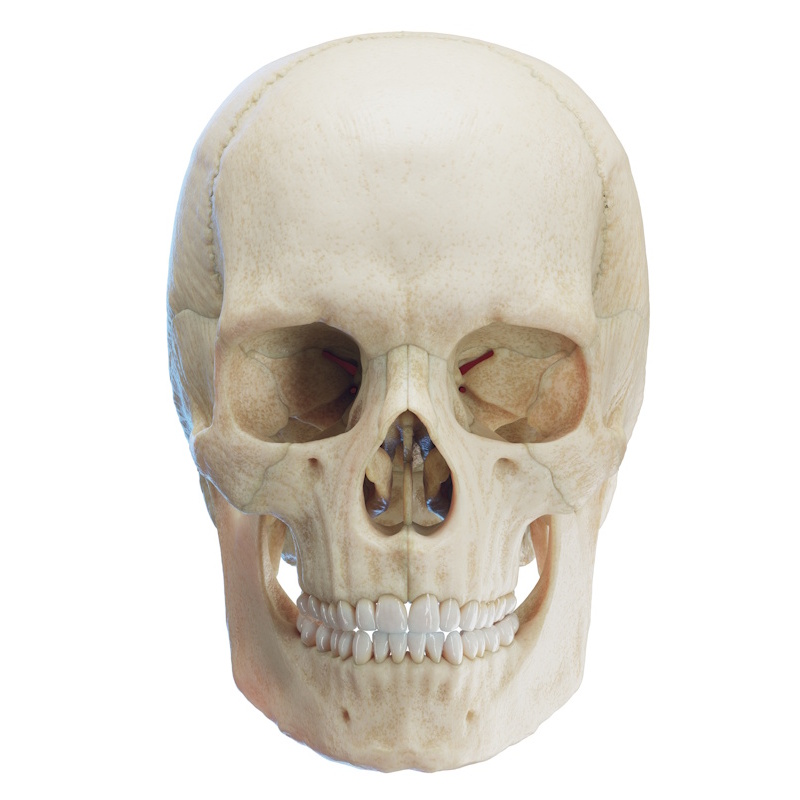
The skull is composed of 22 or 29 bones, depending on whether the hyoid bone and the three auditory ossicles are included. They are joined to one another via sutures, with only the mandible forming the temporomandibular joint with the temporal bone. The primary function of the skull is to protect the brain and associated sensory organs. Beyond its protective role, the skull houses the upper portions of the digestive and respiratory systems.
The skull also contains air-filled bony cavities called paranasal sinuses, which contribute to vocal resonance and help warm and humidify inhaled air. Numerous canals and foramina penetrate the cranial surfaces, serving as passages for blood vessels and nerves. Additionally, the cranial bones provide attachment sites for multiple muscles.
Paired Bones of the Skull
- Parietal bone (os parietale)
- Temporal bone (os temporale)
- Maxilla (maxilla)
- Zygomatic bone (os zygomaticum)
- Lacrimal bone (os lacrimale)
- Nasal bone (os nasale)
- Inferior nasal concha (concha nasalis inferior)
- Palatine bone (os palatinum)
Unpaired Bones of the Skull
- Frontal bone (os frontale)
- Ethmoid bone (os ethmoidale)
- Sphenoid bone (os sphenoidale)
- Occipital bone (os occipitale)
- Vomer (vomer)
- Mandible (mandibula)
- Hyoid bone (os hyoideum)
The bones of the skull can be classified into two main groups: those that form the cranial vault and base to protect the brain (neurocranium), and those that construct the facial skeleton (viscerocranium).
Neurocranium
The primary function of the neurocranium is to shape the head and protect the brain and structures within the cranial cavity.
Bones of the Neurocranium:
- Frontal bone (os frontale)
- Ethmoid bone (os ethmoidale)
- Sphenoid bone (os sphenoidale)
- Occipital bone (os occipitale)
- Parietal bone (os parietale)
- Temporal bone (os temporale)
The neurocranium is further subdivided into two structural parts:
- Calvaria (calvaria): The curved, dome-like vault covering the cranial cavity and its internal structures. It is robust and primarily formed by the parietal, frontal, and occipital bones, with minor contributions from the sphenoid and temporal bones.
- Cranial Base (basis cranii): Forms the floor of the neurocranium and the base of the cranial cavity. It is divided into an internal cranial base (basis cranii interna) and an external cranial base (basis cranii externa), constructed by the temporal, sphenoid, ethmoid, frontal, and occipital bones.
Viscerocranium
The viscerocranium is located anteriorly to the neurocranium. It consists of a collection of bones that form the facial skeleton and support the facial soft tissues. It is composed of fourteen bones, excluding the hyoid bone.
Bones of the Viscerocranium:
- Maxilla (maxilla)
- Zygomatic bone (os zygomaticum)
- Lacrimal bone (os lacrimale)
- Nasal bone (os nasale)
- Inferior nasal concha (concha nasalis inferior)
- Palatine bone (os palatinum)
- Vomer (vomer)
- Mandible (mandibula)
- Hyoid bone (os hyoideum)